Sign in. It’s quick, free and it’s up to you.
An account is an optional way to support the work we do. Find out more.
Sign in. It’s quick, free and it’s up to you.
An account is an optional way to support the work we do. Find out more.

The Housing Essay is a new weekly deep dive from a rotating variety of voices into issues impacting the property crisis in Ireland. Are there potential solutions that may be currently overlooked or traditionally ignored by policymakers?
THE 1973 KENNY Report is remembered for two things: that it recommended that most land likely to be developed in the next 10 years should be compulsorily acquired at existing use (eg, agricultural) values plus 25% – and that it was not implemented.
The existence of two Kenny reports – a majority and a minority one – is rarely remembered. The minority on the Kenny Committee saw the majority proposal as unjust. Like the majority, they felt local authorities should have priority access to development land, so their alternative required it to be offered to local authorities first, and to be subject to a 30% levy.
The constitutional status of the majority proposals loomed large, because the main political parties had urban and rural wings. If a referendum was needed, it would split them down the middle. The practical difficulties were transitional. Buying up most land to be developed in the next 10 years would be expensive, even at agricultural values.
Local authorities would need ample funding for seven to 10 years to do this, and their compulsory purchase orders (CPOs) would need to be processed rapidly, despite fierce opposition. If economic and political conditions were consistently favourable during this transition, a stable, self-funding system might emerge, but Ireland has a highly cyclical economy and competitive politics. If development land was not provided fast enough, a dual land market would emerge, with private sales at far higher prices, leading to a destabilising sense of injustice.
British Labour governments made three attempts to introduce a fairly similar system, the last of these in the 1970s, but were defeated by financial problems and succeeding Conservative governments.
Marx and Engels famously started their 1848 manifesto by saying “a spectre is haunting Europe: the spectre of communism”. Irish housing is, intermittently and on a more modest scale, haunted by the spectre of the Kenny Report. Despite government inaction, it retains a stronger hold on the minds of those dissatisfied with mostly private sector development land supply than any subsequent proposals.
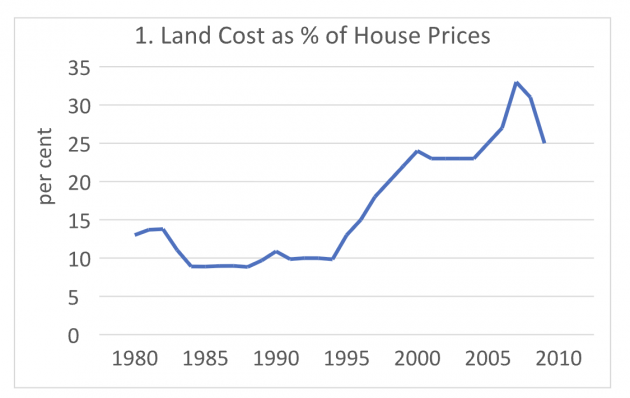
This becomes apparent in periods when the percentage of house prices accounted for by land costs peaks. The first such peak occurred around 1980, prompting the Construction Industry Federation (CIF) to say “the current campaign for the implementation of the Kenny Report reflects a total misunderstanding of the problem”, which could only be resolved by “sufficient zoning and servicing of land”.
 Department of the Environment Construction Industry: Review and Outlook Series
The 1983-7 Fine Gael-Labour coalition responded by setting up a Joint Oireachtas
Committee on the issue. It was advised by economists, who felt Kenny had neglected the role of land prices, in indicating the benefits from alternative land uses, and ensuring land was used for the most appropriate purpose. Artificially depressing land prices could encourage low density development. While there was some land hoarding in inner city areas, selective use of compulsory purchase was the appropriate remedy.
Land costs had declined from 14% of high house prices in 1981-2 to 9% of depressed ones by 1985, when the report was published, so the view that market forces should be allowed to do their job was more favourably received.
But not indefinitely. Land costs rose from 10% of stable house prices in 1991-4 to 24% of rapidly-rising ones by 2000. The then-Minister, Noel Dempsey, more willing to face down the construction industry than his successors, required up to 20% of land zoned for housing to be transferred to local authorities for social and affordable housing, in Part V of the 2000 Planning Act.
When the legislation was published, the CIF magazine Construction had ‘New Planning Bill – recipe for disaster’ blazoned across the cover, describing it as an attempt to control
development land prices in the tradition of the Kenny Report, which, like it, would fail.
Part V was in the Kenny tradition, in that existing use value would be paid for the 20% of
sites transferred for social and affordable housing (development values were about 50 times agricultural ones then). It differed from Kenny in applying only to 20% of the housing land which was actually developed, rather than almost all land likely to be developed in the next decade.
Part V could be modified to allow advance compulsory purchase of 20% of land zoned for housing at existing use values, if the owner had not sought planning permission, or was not implementing it. The percentage – an estimate of households unable to afford housing on the open market in 2000 – might be increased to 25 or 30% now.
There are periodic press reports of very large amounts being sought for units transferred under Part V. Most Part V transactions involve transfer of completed units, as well as the land underneath them, and developers are entitled to their construction costs, plus reasonable profit. They have no motive for minimising those costs – rather the opposite. Existing urban land values may also be far above agricultural ones, if there are existing buildings on site.
Local authorities can side-step this problem on agricultural land, providing the site is large enough for separate development of their 20%, as they can require land only transfers and develop it themselves. They are currently required to zone enough land for 83,000 houses a year nationally, so a lot of land is being zoned.
If local authorities could, if necessary, compulsorily advance purchase and develop their 20%, this would increase social and affordable output. Advance purchase powers could be used strategically to open up large blocks of zoned land in multiple ownership, so that more land parcels had access to services.
There would be a strong case for using such land mostly for two-bedroom terrace houses. As I argued in my housing essay in The Journal on 30 July, their cost should be around 70% of a two-bedroom apartment, so both construction and land costs should be lower. They could be added to the average mixed suburban development without reducing its density.
As Chart 1 shows, land costs resumed their upward march in 2004, hitting a peak of 33% of house prices in 2007. This did not go unnoticed. The All-Party Oireachtas Committee on the Constitution recommended re-examination of the Kenny majority report in 2004, “with a view to implementation”. From 2010 to 2013, an 80% capital gains tax rate applied to land being zoned for the first time, and was presented as a way of implementing the Kenny Report.
The 2020 Housing for All plan proposed a Land Value Sharing (LVS) levy, at 30% of increases above existing use value when land was first zoned. Government bills embodying this were tabled (but not enacted) in 2021 and 2023, and dropped after the 2024 election.
They too were presented as ways of implementing Kenny, but they resembled the 30% levy proposed by the minority report, not the majority one which had popular support. Both reports thought this levy would or could be passed on to house-buyers.
Landowners may defer land sales if the net price they receive is reduced by a tax. If some do, thereby reducing supply, and demand remains constant, gross prices will rise, developers and housebuyers will pay more, and the after-tax price received by landowners will move back up towards its original position. But advance compulsory acquisition could limit passing on, by reducing the ability of landowners to control timing or withhold land.
True believers
The Kenny report still has supporters, which is not surprising, as the market-led development process it aimed to replace has stumbled from crisis to crisis. However, green field suburban development of houses dominated overwhelmingly in the 1970s, but urban brownfield and infill apartment development now dominate policy, and to some extent output. As Chart 2 shows, land costs remain high for semis, particularly in Dublin and Cork, but are proportionately much lower for apartments.
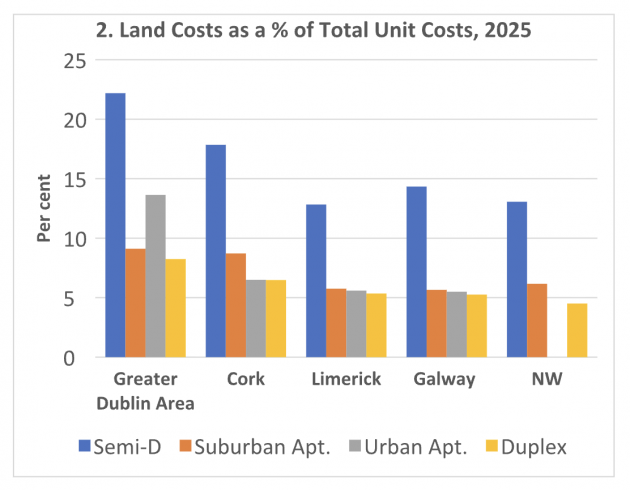 Note: Land costs are expressed as percentages of total costs, excluding VAT Department of Housing Insights into Total Development Costs, December 2025
Paradoxically, apartments are disproportionately expensive, despite having relatively low land costs, while semis cost far less on a per square metre basis, despite having high ones.
The construction costs of different housing types now outweigh land costs. The opportunity referred to above applies primarily to houses on greenfield land, where the existing use value formula is easier to apply. Realising it would involve settling for half a loaf, if that, but it’s the more practical half.
Dr Nicholas Mansergh MIPI was a Senior Planner with Cork County Council until his retirement in 2015. He is the author of The Irish Construction Cycle 1970-2023: policies and escape routes (Eastwood Books, 2024).


have your say