Sign in. It’s quick, free and it’s up to you.
An account is an optional way to support the work we do. Find out more.
Sign in. It’s quick, free and it’s up to you.
An account is an optional way to support the work we do. Find out more.
LAST UPDATE | 5 Nov
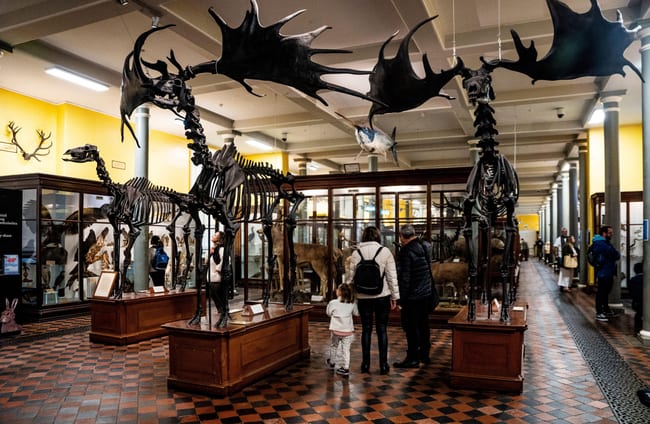
THE CHAIR OF the Public Accounts Committee has said that the Natural History Museum in Dublin will be closed until the “early 2030s”.
In 2024, the museum, sometimes referred to as the Dead Zoo, closed in order to undertake refurbishment and redevelopment works.
The works began in September 2024, and it was originally thought that the museum would be closed for “several years”.
The project will address longstanding issues with accessibility, as well as improve the preservation of the collection.
The building, located on Merrion Street Upper, houses the Dead Zoo, which is home to thousands of irreplaceable specimens, from elephants to insects.
However, the Public Accoutns Committee today heard that substantial construction works are not expected to begin until late 2029 or early 2030.
Back in 2024, keeper of the museum Paolo Viscardi warned that, among other issues, some valuables had been damaged after 2019′s “beast from the east”.
“It snowed in the roof space of this building, because the roof isn’t good enough,” Viscardi told RTÉ at the time.
“That melted and then leaked into the rest of the gallery. So the elephant got covered in water, and that’s not good to taxidermy… Those are the sorts of problems we want to prevent in the future.”
The Public Accounts Committee this morning heard of an update that was provided by the Office of Public Works (OPW) on the redevelopment of the Natural History Museum.
At a Public Accounts Committee meeting this morning, Fianna Fáil TD Paul McAuliffe called for the committee to write to the museum seeking a “more detailed breakdown” of the money spent on redevelopment so far.
In particular, he sought detail on a €2.6 million spend on “investigative works and upfront design costs”.
Committee chair John Brady agreed that the information provided does “not get into specific information”.
“I know there were issues there previously with the stairwell within the premises, which is a fairly old premises,” said Brady, “and certainly it has been cited that additional work is needed.”
Brady meanwhile said he has “concerns that the museum’s been closed since 2024” and that with the “current expected time frame, it’s going to remain closed for nearly up to 10 years”.
“We don’t have an overall final cost,” said Brady.
“€3.6 million has been spent on the enabling and storage costs, so I think it’s an issue.
“I’d have concerns, given the OPW is overseeing this, of the potential for overspend and runaway costs.
“I think we need further sight of the expenditure to date and a more comprehensive breakdown as to the timeline.
“Having such an important museum closed until the early 2030s, I think is quite concerning.
“Absolutely, it does need work, but we need a comprehensive breakdown [of costs].”
The committee agreed to publish correspondence which was sent to it from the OPW last month and to seek “further information” on costings.
Speaking after the committee, Brady joked that “at this pace, we might have a few more fossils to put on display by the time it reopens”.
He added that there is a “lack of urgency” and that “of equal concern is the level of public money already spent on the project, which now exceeds €3.6 million, despite there being no final budget in place”.
“We need firm reassurance that this project will not become yet another example of runaway spending by the OPW,” said Brady.
He also noted that this is not the first time this facility has been closed to the public for an extended period.
It was previously closed from July 2007 until April 2010 after a large section of the stone staircase cracked and collapsed.
“At the time, the OPW and the Department of Arts, Sport and Tourism planned an extensive €15 million refurbishment of the building,” said Brady.
“However, that proposal was shelved before it ever came to fruition, with more localised works eventually undertaken instead at a cost of €500,000 to upgrade the structure, including the replacement of the staircase to the first floor.
“Fast forward almost 20 years, and it appears we are back where we started, with design work now underway once again.
“One has to question whether the OPW is, in effect, duplicating work that was undertaken almost two decades ago, at considerable time and expense.”
The OPW has been approached for comment.


have your say